
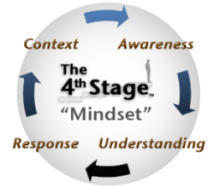
mind•set – A mental attitude and/or disposition that determines how a person responds to certain situations.
Most men try to live their lives in a reasonable way. We think about what we want, and then utilize pertinent data to make rational decisions. Being logical, analytical, and practical are common male traits. However, when it comes to relationships, these innate characteristics seem to elude us.
In this article, we will (temporarily) set aside “why” rational thinking so often disappears when it comes to relationships. Instead, we will focus on how the mission of The 4th Stage can provide a mindset to help you effectively deal with – and derive maximum benefit from – your relationship.
First, let’s identify and define the three fundamental elements of The 4th Stage Mindset: context, awareness, and understanding. All three must work together to effectively deal with relationship issues.
Context defines your relationship. It establishes roles, rules, and conditions, and provides a baseline for measuring results.
Awareness helps you see what’s going on – interactions, events, and circumstances – in your relationship at any given time.
Understanding enables you to apply analysis, logic, and rational thinking so you can respond appropriately.
The beauty of this mindset is, it gives you a useful, practical process for managing virtually all aspects of your relationship.
Situational Example:
You come home after a long day at work. Your wife greets you with a passionate kiss and hands you a bottle of your favorite beer. Dinner is on the table AND she’s looking hot!
The dinner is delicious and she seems genuinely interested in your day. She leans close and says, “You know how we’ve talked about moving into a bigger place in a nicer part of town? Well, I found a place I know you will love as much as I do, AND it’s only a little more than we’re paying now.”
Your 4th Stage Mindset kicks in:
Context – You’ve been together for 5 years, and occasionally celebrate your anniversary, birthdays, and V-day. You both work, she’s always tired, and dinners like this are rare.
Awareness – Today is not your anniversary, a birthday, or V-day, AND she’s looking hot!
Understanding – You analyze the current situation within the context of your relationship: the dinner, her interest in your day, her hotness, AND a proposal to move.
Response – “She created this scenario to coerce me into agreeing to move. I like where we live and moving would mean I’d have to make more money, and I don’t want to work more than I already do. As it is, the stress of my job is adversely affecting my health, and I have practically no time for myself. I need to be honest and tell her I don’t want to move – but later, after we have sex.”
While this is a relatively simple example, the benefits of The 4th Stage Mindset are obvious: it’s a practical way of dealing with virtually any relationship-related situation that’s thrown your way.
We will continue to explore, expand, and refine The 4th Stage Mindset. Stay tuned…
Dear Chazz,
That’s great…. but what do I do when she gets upset when I tell her my true feelings?
“Wondering Worrier”
Wondering Worrier,
Not knowing your (relationship) situation, I can only answer your question in a general way.
First, whether consciously or unconsciously established, ALL relationships exist within a context (4th Stage Mindset: Element #1). The roles, rules, and conditions that define your relationship are introduced over the course of Stages 1-3, and then set in Stage 4. Examples: How are decisions made? Disagreements resolved? What are the communication protocols? Taboo topics? etc. Remember, the purpose of the 4th Stage Mindset is to give you a practical tool for effectively dealing with – and deriving maximum benefit from – your relationship. However, if the context of your relationship has evolved without conscious effort, and especially if it does not serve your needs, consider a thorough examination of your relationship’s “playbook.”
The fact that you need to ask “what to do if she gets upset when you are being honest” tells me that your rules for ‘communicating with each other’ don’t serve your needs. My article “Be true to yourself!” addresses this critically important issue, and I encourage you to read it.
Life is way too short to waste time not being happy! Be honest with your partner, and more importantly, honest with yourself.
Chazz